
Ages 3-5
35-40 min
Body awareness, rhythm, listening, safe-touch boundaries, and adult-directed help-seeking.
Highly directive instruction with visual cues, short partner turns, and simple reflection.
How Classes Work
Each cohort follows a structured class model that combines Jiu-Jitsu movement, guided observation, boundary language, safe-exit practice, and reflection.
Cohort model
1
Instructor
9
Max students
3
Per triad
Two participants practice while one observes with prompts. Roles rotate so every child learns by doing, seeing, and reflecting.
01
02
03
04
05
Ages 3-5
Body awareness, rhythm, listening, safe-touch boundaries, and adult-directed help-seeking.
Highly directive instruction with visual cues, short partner turns, and simple reflection.
Ages 6-8
Rule-following, confidence, refusal language, simple scenario recognition, and guided cooperation.
Brief verbal check-ins, simple readiness tools, and structured transition support.
Ages 9-12
Decision stability, boundary articulation, impulse control, analytical observation, and early leadership.
Full triadic rotation, richer scenario language, and short self-assessment.
Ages 13-17
Composure under pressure, social influence navigation, bystander action, leadership, and mentorship readiness.
Deeper scenario analysis, report-route rehearsal, and age-appropriate leadership tasks.
Class flow
The structure is designed to keep classes consistent across schools, nonprofits, faith-based organizations, and community sites while still adapting language and intensity by age band.
Arrival, attendance, readiness check, and safeguarding visibility review
Movement prep with breath, posture, balance, locomotion, and rhythm
Technical focus with clear objective, language cues, and safety constraints
Guided drill blocks with correction, partner rotation, and calibrated intensity
Positional game and triadic rotation with two active participants and one guided observer
Scenario application connected to safe exit, help-seeking, or proportional response
Value integration where participants name the boundary or decision principle
Closeout with a concise message and, when appropriate, a guardian-facing note
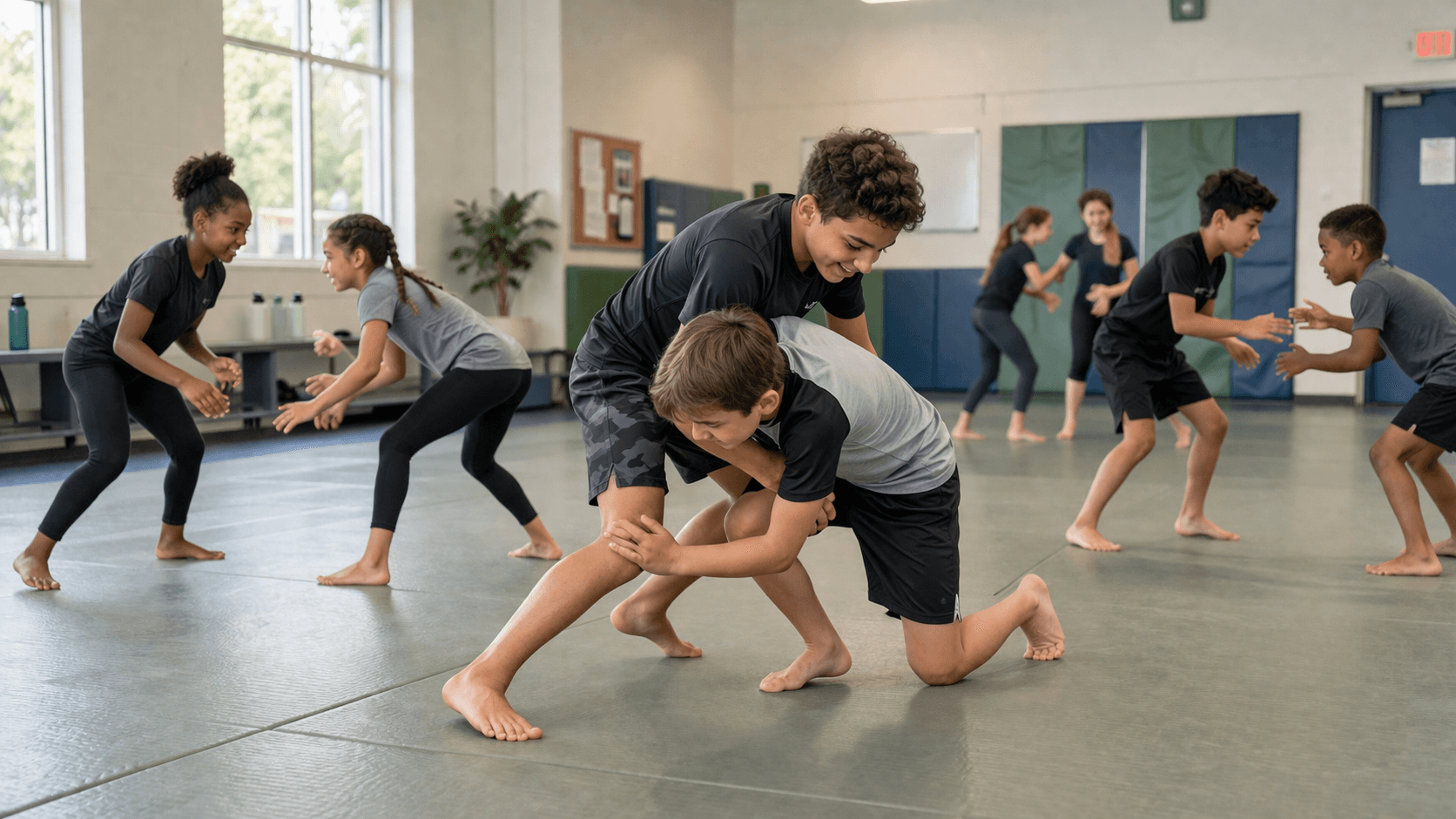
The cohort model uses one instructor with up to nine participants. Students work in triads: two practice a defined task while the third observes with prompts, then roles rotate.
Do
Observe
Rotate
Mastery cycle
The goal is not flawless first-pass performance. Participants strengthen protective self-efficacy through coached attempts, regulated recovery, improved reattempts, and guided transfer reflection.
Program rhythm
The standard cadence is two instructor-led sessions per week. One session per week may be approved when scheduling, transportation, staffing, or site conditions require it.
8 weeks
Used for host-site pilots, proof of fit, and institutional adoption. Week 1 sets intake and baseline; Weeks 2-6 rotate domains; Week 7 reviews integration; Week 8 closes with post-cycle review and recognition.
12 weeks
The default host-site model. Week 1 handles orientation and baseline; Weeks 2-10 cycle through modules; Week 11 reviews scenarios and documentation; Week 12 closes with assessment and Family Demonstration Day.
Two 12-week cycles
Designed for school-year or longer site delivery. Cycle A establishes baseline and stage movement; Cycle B deepens reinforcement, leadership exposure, and cumulative review.
Safety and readiness
Each host site confirms space, schedule, roster, consent, arrival and dismissal procedures, safeguarding contacts, emergency paths, and record confidentiality before classes begin.
Two-adult visibility during delivery, transitions, and dismissal
Parent or legal guardian consent for minors unless a documented institutional pathway applies
Medical notes, emergency contacts, and photo/video permissions reviewed before participation
No unsupervised one-adult/one-child isolation during program delivery
Instructor-controlled partnering with the ability to change pairings at any time
Objective documentation and prompt escalation for safeguarding concerns
Participants begin with consent review, orientation, self-check, instructor observation, and a simple functional scenario baseline.
Instructors track observable growth such as pause-before-reaction, recovery after error, boundary voice, safe exit, and help-route activation.
Foundation, Stabilization, and Leadership recognition is based on demonstrated readiness, not automatic cycle completion.
Family engagement
Families receive orientation, progress communication when site policy allows, and an end-of-cycle summary focused on growth, values, and next steps within program scope.
The cycle can close with safe demonstration stations, instructor narration, family cue language, stage certificates, domain seals where applicable, and next-step information.